Arizona Pool Maintenance Calendar: Monthly Tasks for Phoenix Owners
Month-by-month pool maintenance guide for Phoenix. What to do each season, Arizona-specific tips, and how to keep your pool in peak condition.
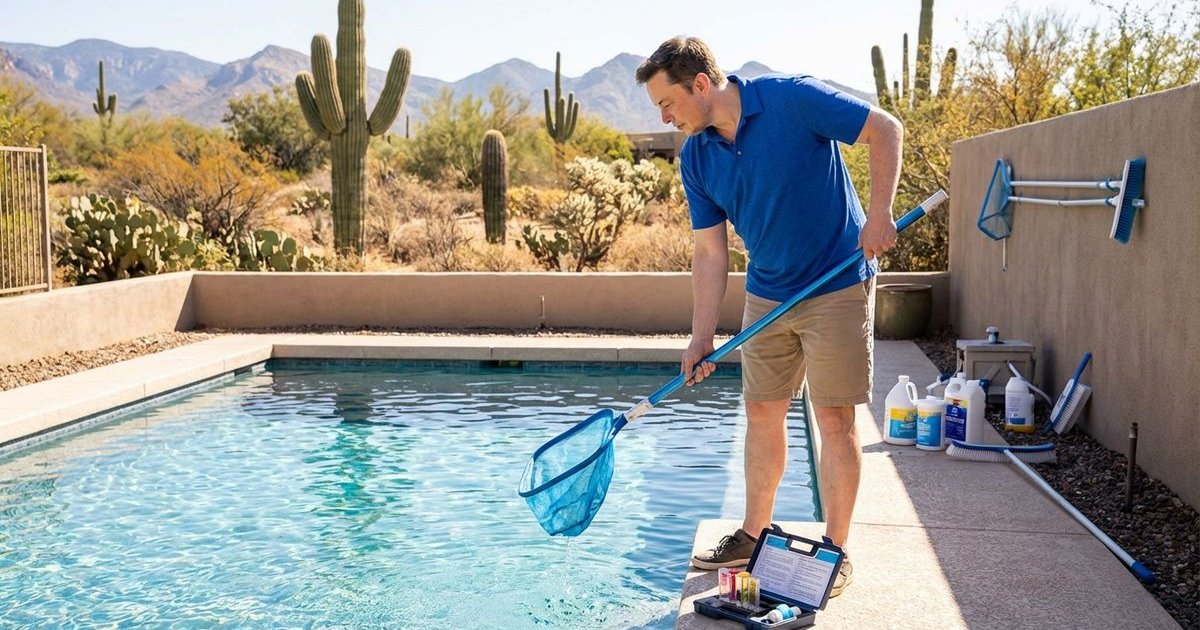
Arizona pool maintenance isn’t like anywhere else. Our intense heat, monsoon dust, and year-round swimming season require a unique approach. Here’s your month-by-month guide.
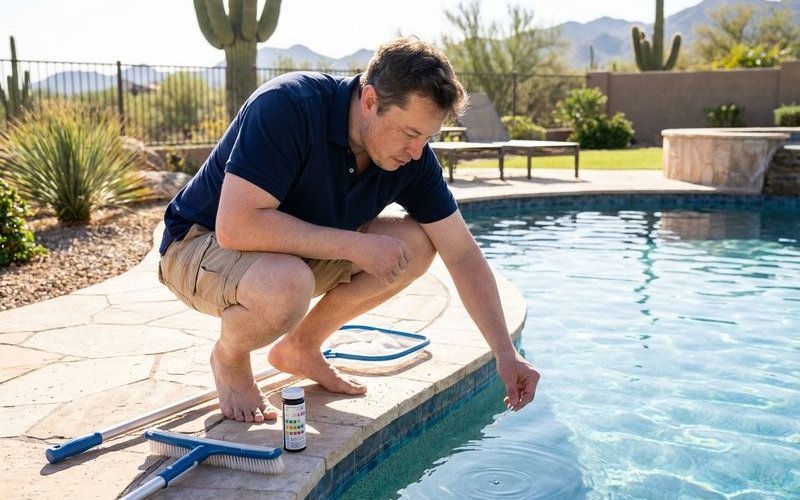
January - February: Winter Checkup
Even Arizona winters require attention. You know how tempting it is to ignore the backyard when it’s 50 degrees out, but this is actually the critical season for preserving older plaster.
Weekly Tasks
- Test and balance water chemistry: Keep pH between 7.4 and 7.6 to prevent etching.
- Skim surface and empty baskets: Leaves from deciduous trees are still falling.
- Brush walls (weekly minimum): Sediment settles quickly in colder, still water.
- Check pump and filter operation: Listen for grinding bearings that sound louder in the cold air.
Monthly Tasks
- Clean or backwash filter: A dirty filter raises pressure and costs you money.
- Inspect equipment for issues: Look for “freeze guard” sensors on your automation system to ensure they trigger at 36°F.
- Check water level: Evaporation drops to about 1/4 inch per week, but leaks can still happen.
- Test pump pressure gauge: Verify it returns to zero when the pump is off.
Arizona-Specific
- Water temps drop to 50-60°F: Algae growth slows but doesn’t stop completely.
- Perfect time for repairs: Pool resurfacing projects are safest now because the risk of thermal shock to the shell is lowest.
- Check heater function: Fire it up before you actually need it for a weekend party.
- Dust storms can still happen: Winter storms bring fine silt that bypasses skimmers.
March - April: Spring Preparation
Swim season approaches. Time to prepare.
Weekly Tasks
- Test chemistry twice weekly: As water warms, chlorine demand begins to tick up.
- Increase brushing frequency: This removes biofilm that winter algae established.
- Skim more often: The pollen invasion begins now.
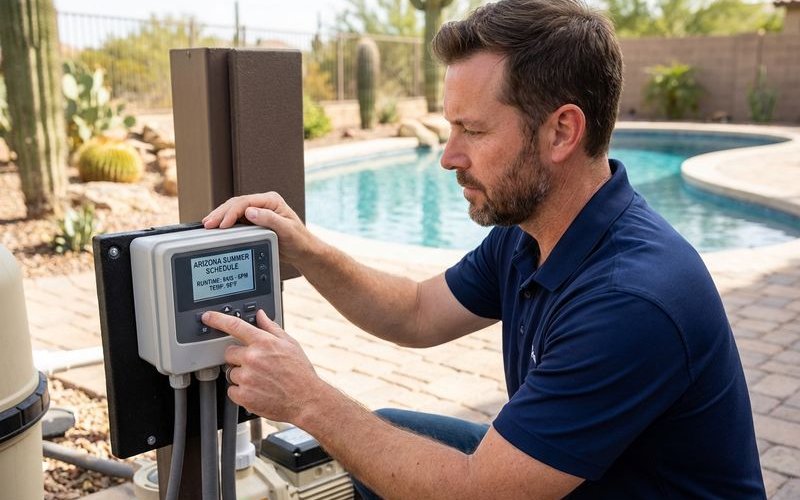
- Run pump longer: Shift your Variable Speed Pump (VSP) schedule to run higher RPMs during the day.
Monthly Tasks
- Deep clean filter: Disassemble cartridge filters and soak elements in a TSP (Trisodium Phosphate) solution to remove oils.
- Inspect tile and waterline: Look for “calcium nodules” or small white bumps that indicate aggressive water is eating your plaster.
- Check equipment seals: O-rings often crack as temperatures swing from cold nights to hot days.
- Clean deck: Power wash the Cool Deck to remove winter grime before bare feet hit it.
Arizona-Specific
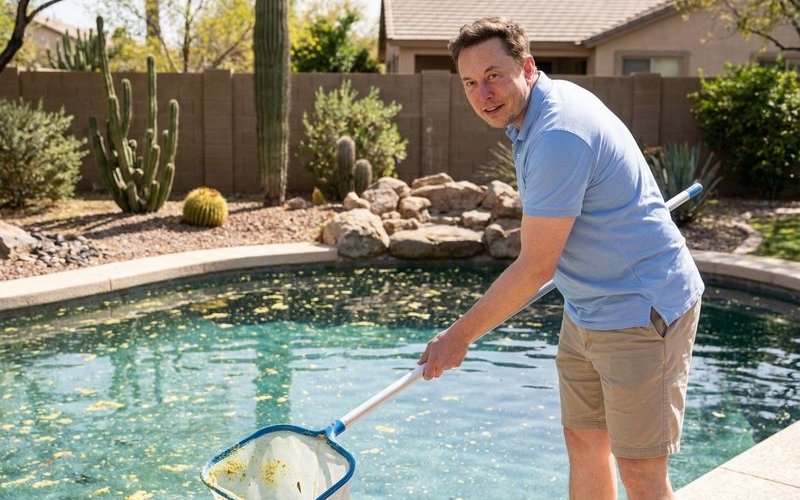
- Palo Verde bloom season: Expect a carpet of yellow flowers that clog skimmer baskets in hours.
- Water starts warming rapidly: You will see a jump from 60°F to 75°F in just a few weeks.
- Begin adjusting pump runtime: Move from 6 hours to 8 hours daily.
- Ideal time for Cool Deck touch-ups: Paint adheres best when highs are in the 80s, not 100s.
May - June: Early Summer
Usage ramps up. Heat and chemical demand increase.
Weekly Tasks
- Test water 2-3 times per week: Consistency is your only defense against sudden algae blooms.
- Brush walls and floor thoroughly: Focus on steps and benches where circulation is poor.
- Empty skimmer baskets frequently: Mesquite trees drop pods that stain plaster brown.
- Monitor chlorine levels: Keep Free Chlorine at 3-5 ppm as UV index rises.
Monthly Tasks
- Clean or replace filter cartridge: If the bands are broken or the pleats are fuzzy, buy a new one.
- Check for leaks: The bucket test is essential if you lose more than 1/2 inch of water daily.
- Inspect pool surface: Look for spider cracks that may have opened during the heat transition.
- Verify pump timer: Ensure your run cycle covers the hottest part of the day (1 PM - 4 PM).
Arizona-Specific
- Water temps reach 80-90°F: Chlorine evaporates almost as fast as you add it.
- Switch to liquid chlorine: Tabs add Cyanuric Acid (CYA), and our high evaporation rates make CYA buildup a major problem.
- Watch for algae blooms: Mustard algae loves this specific temperature range.
- Run pump 10-12 hours minimum: Circulation prevents dead spots where algae breeds.
Insider Tip: Watch Your LSI
We see too many homeowners focus only on pH and chlorine. The Langelier Saturation Index (LSI) is the true secret to making old plaster last. This formula balances pH, alkalinity, calcium, and temperature. If your LSI is too low, the water becomes “aggressive” and eats the calcium right out of your pool walls, causing rough spots.
July - August: Peak Heat & Monsoon
The toughest months for Phoenix pools.
Weekly Tasks
- Test water 3+ times per week: Daily testing is even better during active monsoon weeks.
- Shock weekly: Use liquid shock to avoid adding extra calcium or stabilizer.
- Brush daily if possible: Dust brings phosphates, which are fertilizer for algae.
- Clean skimmers after every storm: Do not let organic debris sit in the basket overnight.
Monsoon-Specific Tasks
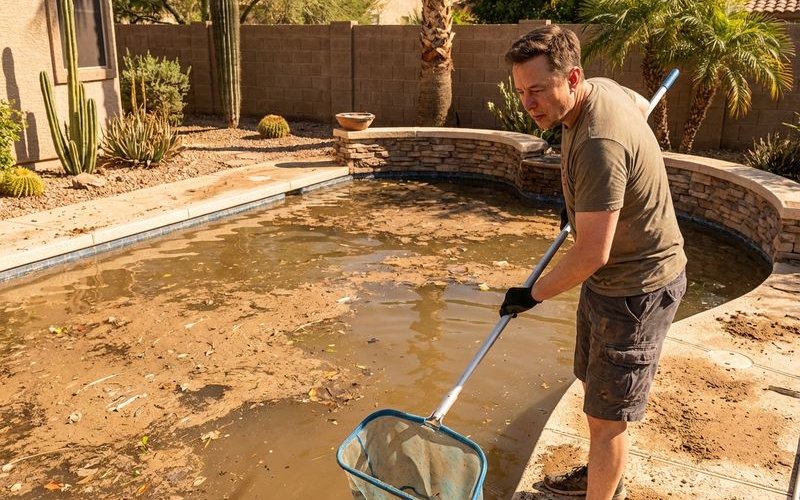
- Clean pool immediately after dust storms: Scoop large debris before it sinks and stains.
- Check salt cell frequently: High heat and usage cause scale buildup on the plates faster than usual.
- Test phosphate levels: A reading over 500 ppb requires a phosphate remover treatment.
- Run pump extra after storms: Keep water moving for 24 hours straight after a “haboob” passes.
Arizona-Specific
- Water temps can exceed 90°F: Your chlorine is working overtime and dissipating rapidly.
- Haboobs dump tons of dust: This dust is often rich in nitrates and phosphates from local agriculture.
- Algae grows incredibly fast: Green blooms can take over a clear pool in 48 hours.
- Equipment works hardest: Pump motors can overheat, so ensure the cooling vents are clear of debris.
Critical Warning: Do Not Drain
We cannot stress this enough. Never drain your pool completely in the summer. The intense heat can cause the plaster to delaminate (pop off the shell) or even cause the shell itself to crack due to thermal shock. If your water chemistry is unmanageable, do a partial drain-and-refill of only 1-2 feet at a time.
September - October: Transition Season
Heat begins to ease. Adjust your routine.
Weekly Tasks
- Reduce testing to 2x weekly: You can relax slightly as the UV index drops.
- Continue regular brushing: Removing summer scale buildup helps the pool look better for winter.
- Skim leaves as trees shed: Fall in Arizona is subtle, but debris still increases.
- Monitor decreasing chlorine demand: You will need significantly less sanitizer as water cools below 80°F.
Monthly Tasks
- Deep clean filter: This is the most important filter clean of the year to remove monsoon mud.
- Inspect equipment: Listen for pump noises that might indicate bearings were worn during the summer marathon.
- Check pool surface condition: Look for waterline tile scale that needs a pumice stone.
- Clean deck: Remove monsoon dust stains from the patio.
Arizona-Specific
- Perfect weather for pool enjoyment: Water temperature naturally settles into the low 80s.
- Water cools gradually: Don’t turn off the auto-fill yet as evaporation is still significant.
- Consider scheduling inspections: Pool companies are less busy now than in spring.
- Reduce pump runtime: Dial back to 8-10 hours to save on electricity.
November - December: Winter Prep
Cooler temps, lower maintenance—but don’t neglect your pool.
Weekly Tasks
- Test water weekly: pH tends to drift up naturally in our hard water environment.
- Skim and brush as needed: Keep the surface polished even if you aren’t swimming.
- Check equipment operation: Verify the “freeze protection” mode on your pump is active.
- Empty baskets: Pine needles and other winter debris can still cause clogs.
Monthly Tasks
- Clean filter thoroughly: A clean filter ensures water flows freely if a freeze warning hits.
- Winterize equipment: If you have a solar heater, drain the panels to prevent freeze damage.
- Inspect for repairs: Look for grout cracking that needs attention before next summer.
- Check lights: Replace burned-out bulbs now while the water is clear and calm.
Arizona-Specific
- We don’t “close” pools: The water must circulate to prevent stagnation.
- Perfect time for resurfacing: Winter is the safest season to drain a pool for plaster work.
- Lower chemical costs: You might only need one gallon of chlorine every two weeks.
- Keep filter running: Stagnant water is a breeding ground for mosquitoes even in winter.
Quick Reference: Pump Runtime by Month
| Month | Water Temp | VSP High Speed | VSP Low Speed | Total Runtime |
|---|---|---|---|---|
| Jan-Feb | 50-65°F | 2 hours | 4 hours | 6 hours |
| Mar-Apr | 65-80°F | 3 hours | 5 hours | 8 hours |
| May-Jun | 80-90°F | 4 hours | 8 hours | 12 hours |
| Jul-Aug | 85-95°F | 6 hours | 8 hours | 14 hours |
| Sep-Oct | 80-85°F | 4 hours | 6 hours | 10 hours |
| Nov-Dec | 60-75°F | 2 hours | 5 hours | 7 hours |
Chemistry Targets (Year-Round)
| Parameter | Target Range |
|---|---|
| Free Chlorine | 2-4 ppm (Summer: 4-6 ppm) |
| pH | 7.4-7.6 |
| Total Alkalinity | 80-120 ppm |
| Cyanuric Acid (CYA) | 30-50 ppm (Max 80 ppm) |
| Calcium Hardness | 250-400 ppm (Phoenix Avg: 600+) |
| Phosphates | 0-100 ppb |
Arizona Notes
- Our hard water means calcium levels run high: Phoenix tap water often comes out at 250+ ppm already.
- High CYA is the silent killer: If your CYA exceeds 100 ppm, you must drain and refill to regain chlorine effectiveness.
- pH tends to rise in our heat: Acid demand is constant here, so keep Muriatic Acid on hand.
Annual Professional Services
Even DIY pool owners benefit from annual professional attention:
- Equipment inspection: A pro can spot a capacitor failing before your pump dies in July.
- Leak detection: We use ultrasonic listening devices to find leaks under the deck that you can’t see.
- Surface inspection: Identifying “hollow spots” in plaster now prevents large chunks from popping off later.
- Tile and grout check: Sealing that expansion joint between the pool and deck prevents major structural shifting.
When to Call a Professional
Beyond routine maintenance, get help for:
- Persistent algae despite treatment: This usually signals a phosphate or filtration issue.
- Equipment malfunctions: Loud screaming noises from a pump mean the bearings are shot.
- Visible surface damage: Cracks longer than 2 inches need professional staples or epoxy.
- Water loss beyond normal evaporation: Losing more than 1/2 inch a day is a leak.
- Deck damage or settling: uneven slabs create trip hazards and drainage issues.
Early intervention prevents expensive repairs.
Free Pool Assessment
Want a professional eye on your pool? We offer free assessments that include:
- Surface condition evaluation
- Equipment inspection
- Deck assessment
- Recommendations for any needed work
Contact us to schedule your assessment.
Need Help With Your Pool?
Our team has 15+ of experience helping Phoenix homeowners with pool resurfacing and renovation. Get a free, no-obligation estimate.